February 12th 2017
It is surprisingly nippy as we set sail down the Irrawaddy before dawn and I scramble to locate long-neglected fleeces and socks. There are a couple of options to reach Bagan by boat: The local boat will be more interesting but this is the dry season and it is navigated through the increasingly shallow river by a boy on the prow with a depth stick, so it will inevitably run aground. At best this means the arrival time is aspirational, at worst a night on a sandbank. My hotel guys steer me to one of the tourist boats. Not the one with teak loungers and signature cocktails, unfortunately, instead they book me on the one that sits highest in the water and has sonar even if the other passengers are French and Belgians, who would rather talk to me than each other, a mansplaining Canadian lady who has evidently not talked to anyone for a week, and my first Americans. A nice young family from Eastham of all places, doing spring break in Burma before decamping to the Canary Islands to sit out the Trump era.

The Irrawaddy is splendid in the shimmering heat that soon develops and even with necessary zigzags we make it in a mere 12 hours, cruising smugly past other boats listing sadly, stuck for who knows how long in the treacherous shallows.
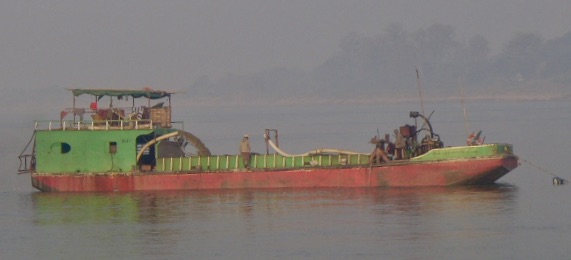
Bagan, which is currently scoring at least an 8 on the hotter-than-hell index, must advertise itself as the fairy light capital of the world, but we are here to experience the 2000 plus temples scattered throughout the Bagan plain.
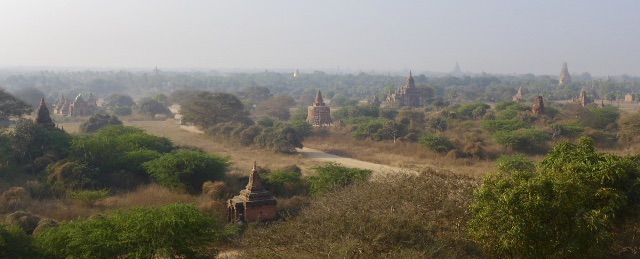
The sheer vastness raises the inevitable question of access and the inevitable specter of the e-bike. In its Chinese version, which we have here, the e-bike resembles a Vespa more than a bicycle. Since the dawn chorus, dominated by Buddhist chants, begins at 4:30 in Bagan I have had plenty time to contemplate my deeply ingrained instinct to grab the accelerator handle and speed up when confronted with a crisis. After a couple of trips up and down the lane, the nice old e-bike man and I reach the mutual conclusion that this old dog is unlikely to learn the new trick in the time available, and points me to the normal bikes. I examine every single one before finding the killer trifecta of functioning brakes, more than one gear and inflatable tires. He insists I take his phone number.
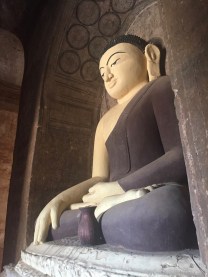 The heyday of the Buddhist Empire these monuments celebrate was in the 11th century, so some wear and tear is anticipated. It has been hastened along by a 2016 earthquake and not ameliorated by UNESCO pulling out of the renovations in a huff. So some of the temples are sheathed in bamboo scaffolding and others by piles of bricks. This will be the last season we are allowed to scramble on them willy nilly.
Still, the huge area engulfs the few tourists and most are deserted, leaving the vendors forlorn. At some remote spot, I find myself enticed into buying a sand painting which the artist assures me is washable, although not in the machine, a selling point I have never yet encountered for artwork. He also assures me it can remain folded in my suitcase for years, secure in the notion that even if I did come back to argue the point I would never be able to find him.
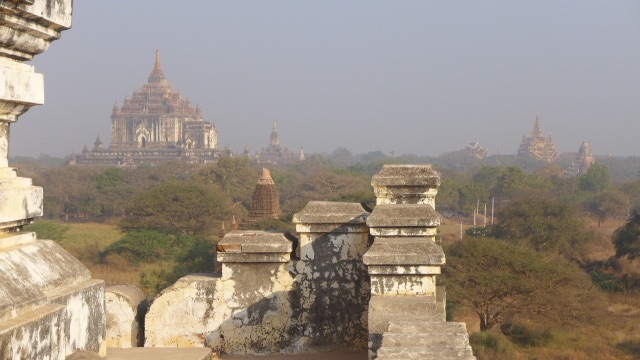
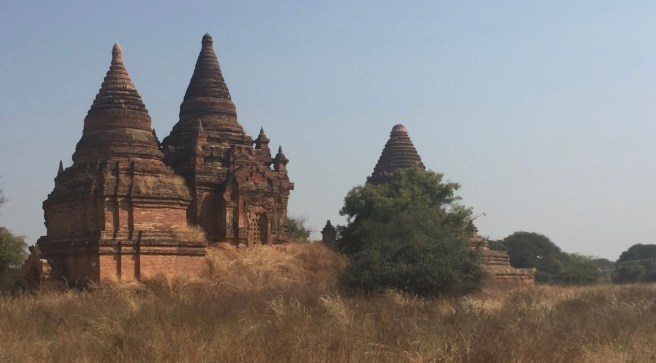
 This backdrop invites the full spectrum of foreign tourists. In our demographic, apprehensive Germans and Dutch, firmly tethered to their Burmese guides are being herded into the bad Thai restaurants and forbidden to go into the market. Timid Brits, though usually not in tour groups, travel in pairs tethered to each other and never seem to talk in public. The French are either in loudly discordant groups arguing about which of the 2 versions of Burmese red will go best with the Thai chicken they don’t yet realize is unbearably bland, or in couples where le homme affects a no-nonsense bandana and unnecessarily complex backpack, and la femme is impeccably turned out in an insouciantly couture longyi. They have many conceptions (both pre- and mis-) and debate them endlessly. There are no shopping opportunities in Pyin U Lin, so all the Chinese are at the Botanical gardens taking selfies and ignoring the no photographs sign in the world class butterfly museum. There are no Americans.
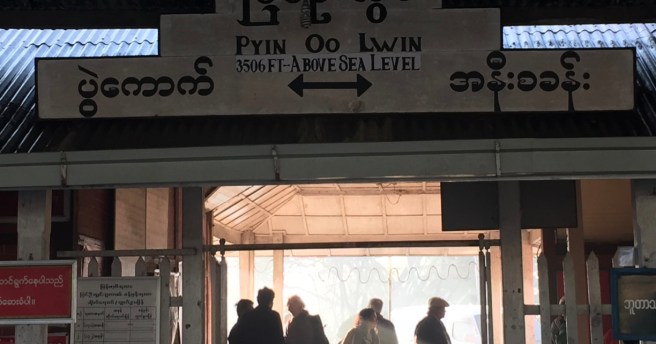 Most of us Europeans are not here to reflect on the death of the Raj but to experience its most enduring relic – the half hour train ride across the Gokteik viaduct, engineered and constructed by the British, and since they disappeared lackadaisically maintained by the Burmese.
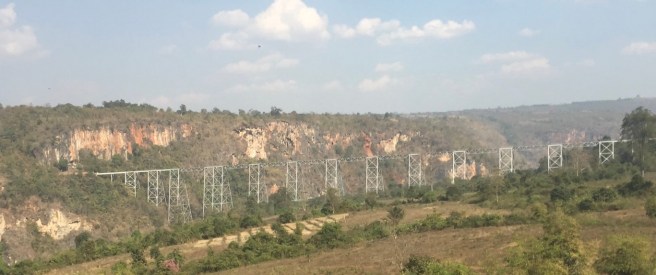 As Paul Theroux writes “A monster of silver geometry in all the ragged rocks and jungle…its presence there was bizarre, this man-made thing in so remote a place, competing with the grandeur of the enormous gorge and yet seemingly more grand than its surroundings which were hardly negligible – the water rushing through the girder legs and falling on the tops of the trees, the flight of birds through the swirling clouds and the blackness of the tunnels beyond the viaduct.”
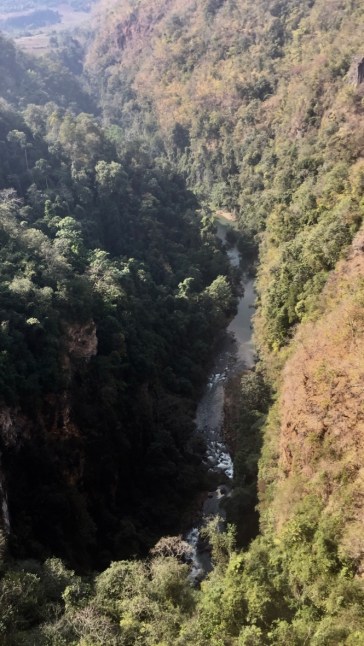 It should be pointed out the reason Burmese train travel resembles a horse ride is the disconnect between the gauge of the tracks (British) and the current trains (ancient Chinese, no doubt bought cheap). Managing this disconnect is no more crucial than 1000 feet above the rushing river below, and doing so requires the train travel so much slower than walking speed, so we have plenty of time to reflect whether guard rails didn’t make it into the maintenance budget, or the British already realized they would be futile, or it is irrelevant to the Buddhist Burmese whether life ends because of a gust of wind. Most tourists can recover as they continue onward to points north, but I must leap off the train at the first stop and join the returning train to Pyin U Lin. Seated once more in Ordinary Class, I realize the Burmese deal with near-death experiences by eating lunch and watching videos on their iphones.
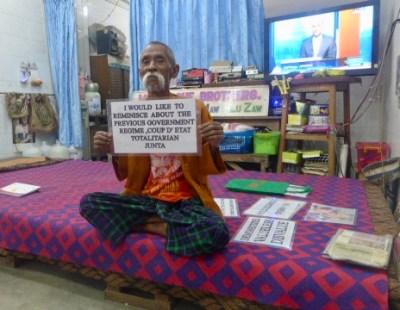 I consult my guys at the desk and they agree that an outing to the Moustache Brothers (the satirical vaudeville troupe strongly critical of the junta) may be just the job. My motorbike taxi is less keen; when we get there and he can’t find it he circles the block in a panic rather than ask directions, convincing me this is a truly subversive event. It certainly has potential: Only one Moustache brother is left, not because he’s so geriatric (which he is) but because brother #1 has succumbed to lead poisoning from the prison water he had to drink for 7 years, while brother #3 never even made it back. So, the remaining brother, #2, was left holding down the ‘irritate the junta’ fort until they came up with the, I must say, brilliant idea of not putting him into prison and turning him into a folk hero, but rather permitting him to perform only in English, thereby ensuring the average Burmese will never be able to understand what he’s saying.
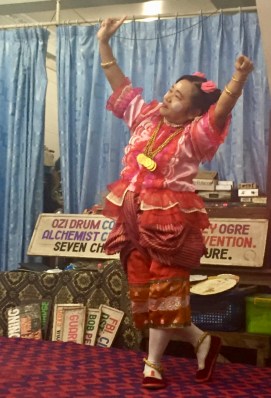 It’s tough on the motley crew of Danes, Italians, English and Aussies in the audience too, but he helps us out by brandishing laminated placards with inflammatory comments as he tells political jokes. The best one: “My teeth were bad, so I went to dentist in Thailand. He say to me, Mr. Paw Paw Le you are from Burma. No dentists in Burma? And I say to him. Yes, there are, but we are not allowed to open our mouths”. He insists we take pictures and tells us via another placard to post them on Facebook. The rest of the troupe – his equally senior wife, sister, sister-in-law and cousin provide interludes of surprisingly energetic classical Burmese dance. They all look like they’re dying to go to bed and I feel for them. Still no answers. Has he become a clown who needs to retire his red nose, or is he still a serious provocateur, as the (ancient) photos plastered on the wall suggest he once was? His video of Aung San Suu Kyi laughing at his jokes is from 1996, so we are none the wiser.

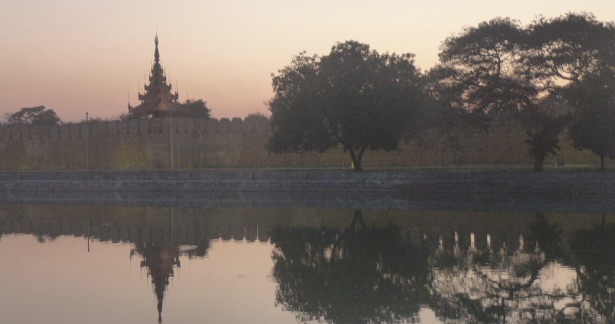
 In the event, I find one of them from the guidebook (the whole Tipitaka inscribed onto 1794 stone tablets each in its own little house!), stumble on the second, which has been mislabeled on the map (massively carved teak, ladies not allowed into the inner chamber).
  I completely fail to find the third, in large part because people who have clearly been born and bred in the vicinity seem to have no idea of what the streets they live in are called. Let it be noted that the streets are labeled, 1st 2nd 3rd etc.; the pagoda in question was supposed to be on 86th, which is pronounced in Burmese as “Eighty sixth”.
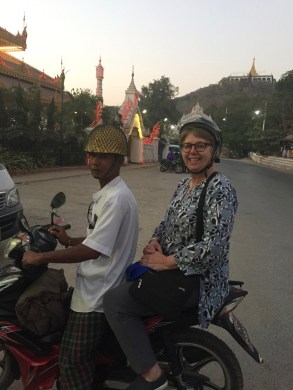 My final foray is to the inevitable pagodas of Mandalay Hill, which deliver superb views of the sunset over the distant Irawaddy river. Not so fast! As I am locking up the bike I am accosted by an old man in a jungle war helmet, complete with netting. ‘Mama, Mama too late!’ He tells me brandishing his iphone as proof. Evidently sunset will occur in precisely 30 minutes, while the climb up the hill will take 45. Although I find this somewhat surprising since I too checked with Google, I do tend to agree that reaching the top breathless and in the dark, would be unfortunate. His proposed solution is to ferry me up post haste on the back of his somewhat underpowered motorcycle and wait until I finish photographing all the other tourists who will be blocking the view. My experiences with Myanmar’s robust traffic have made me apprehensive to try a motorcycle taxi, but this more controlled environment seems like a perfect opportunity. I put on a (more conventional) helmet, sling my leg over the back (to general disapproval; women generally ride side saddle) grab him firmly by the right shoulder as etiquette demands, and implore him to go slowly.
 February 6th 2017
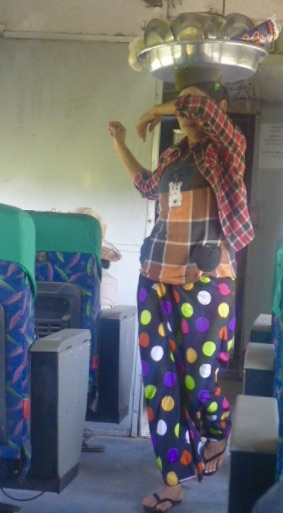 The Burmese eat constantly, so keeping them fueled for a full 15 hours takes a serious masterplan. The onslaught of vendors appears the minute the whistle blows; breakfast – corn on the cob and those quail eggs no-one likes – is a bust, everyone, including me, has brought their own. But the Nescafe with sweetened condensed milk, is excellent and I am fortunate to discover in the nick of time that the teenage girl who is the hotel night manager has packed me soft boiled eggs. I avert disaster by eating them out of the window. For lunch my across the aisle family (I am the only foreigner on the train) give me permission to buy an odd looking peanut curry but with frantic arm gestures (they don’t speak English) suggest strongly I don’t eat the meat, which indeed looks like it might have been regifted a few times previously. Fruit, including a delicious dryish smoked banana with the texture of figs and dates, dinner and finally, whisky (my family don’t approve so I also shake my head primly). It should be pointed out merchandize is carried on the head, and then the horse ride analogy should be recalled. Different teams of vendors jump on when we stop and then are replaced at the next stop or so. This revolving crew can thereby provide the breadth and depth of menu options the Burmese clearly expect. Their ability to get back home after a day’s work suggests Myanmar railways may be more coordinated than it initially appears.
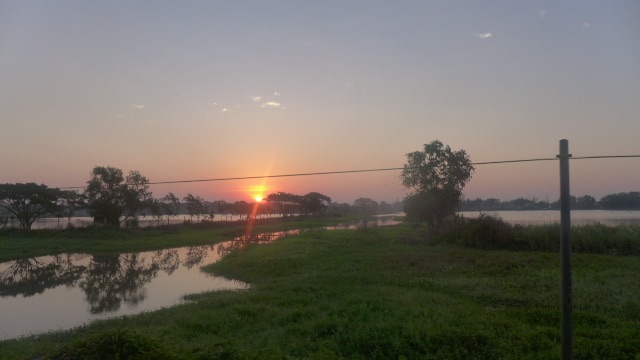 Through rural Burma at 20 miles an hour. All of it is a plain, but not a bit boring! Every inch is cultivated. And the texture and intense detail in the landscape mesmerizes me from 6am when we set off, until 6pm, when it finally gets dark. We are going just a bit too fast to take good pictures. So I need to take an inventory instead:
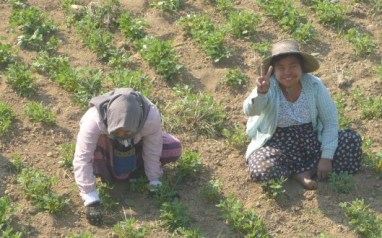 7am to noon moms are allowed to plant and pick in the fields, depending on the crop (this is when dads watch the moms and do their strategic planning). At noon moms go home and pretend to do housework while chatting with their friends (this is most easily accomplished if your friend lives next door). At 4pm moms hike their skirts under their armpits and pour water over themselves, then they disappear. Millenials: Both male and female hop onto little tuk-tuk scooters at 7am and leave. It is not clear where they are going because of the dearth of decent sized places (see above) still, they go, and then they come roaring back at 4pm. Sometimes the boys will go and herd some cows.
  Kids: Are dressed in their uniforms and off to school at 7am. Some of them walk along the railroad tracks and some have bikes, so they can give 3 lucky friends a ride. They come back in a better mood at 4pm. Then boys play volleyball and girls go to fetch water. After, girls get together and whisper a lot. Little kids: Little boys are allowed outside the compound to kick sand with their friends all day. Sometimes they pretend to throw rocks at the train. After 4pm they harass their brothers. There are no little girls. Grandma: Pinch hits for mom in the morning but more effectively because she has a louder voice. Grandpas: Worry a lot about Myanmar Rail so they gather at the station and congratulate themselves when the train arrives. Note: Some moms and dads travel on the train, but can it be for work? there are only 2 trains a day and in any case, there is nowhere near to go.
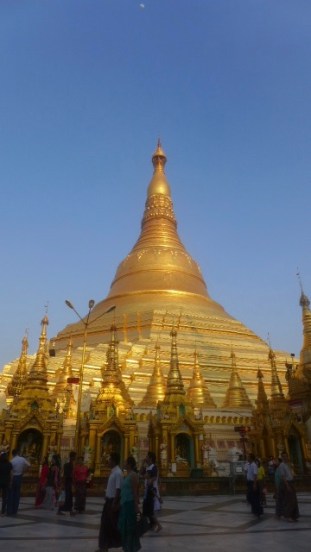 Pagoda: ‘The Shwe Dagon rose superb, glistening with its gold, like a sudden hope in the dark night of the soul of which the mystics write glistening against the fog and smoke of the thriving city’. It must have been 4 o’clock in the morning in the middle of monsoon. Today, on a sunny winter Sunday afternoon, all Yangon is here with their picnics.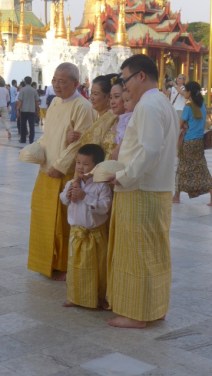
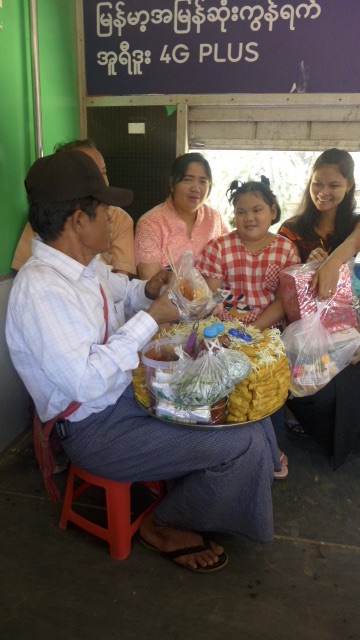 way find farmers plowing with buffalo or thigh deep in water harvesting the ubiquitous morning glory, rather than McMansions). Picturesque yes but the actual action happens inside the train. At first it’s fairly banal, (water, cookies) ramps up gradually (the lady with strawberries on her head, the guys with a pot cooking sweetcorn) a quick detour through quail eggs (are they cooked? In any event, no-one’s buying) to samosa chaat (prepared a la carte at our feet) to the full noodle café (uploaded, feeds us all and detrains within the space of half an hour). We’re half way into the trip when the mobile chefs are quickly replaced by massive sacks of morning glory destined for Yangon dinner tables tonight.
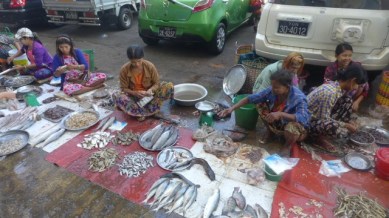 in less than 24 hours I am smitten. It is a walking city, as the whole population proves by spilling onto the crumbling sidewalks as soon as the sun goes down. Yangonis are swarthier and their resting face more stoic than the twinkly Thais, but in their long skirts and flip flops (men and women) they waft rather than walk. I feel cocooned rather than confronted, unlike Delhi, which it most closely resembles in terms of urban decay and the smell.
 The night market snakes along the riverfront and into Chinatown for over a mile, stunningly illuminated with red lanterns in honor of New Year. The thousands of food stalls are packed elbow to elbow and, like most Yangonis it seems, I am set on barbecue.
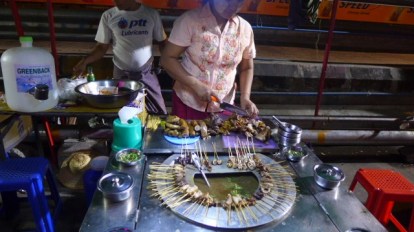 re lined up and inexplicably, what seem to be whole eggs are bobbing in the hot oil. The competition ends when all the skewers are finished (it is OK to leave the kidneys). This isn’t going to work. Not only can no-one take the time to tell me what I’m eating but I’d likely be plopping myself into the midst of someone’s engagement party.
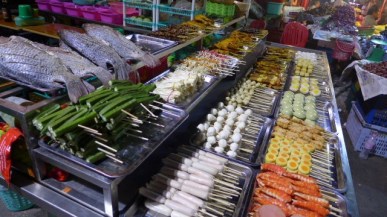 gs) others I don’t quite (is it morning glory or lotus root, and what do either taste like?) generic meat, seafood and fish. In one case, enormous multicolored lobsters have collected quite an audience. I figure out the drill is to fill a plastic basket with the skewers of your choice, hand it to the grill master and then grab a plastic stool even if the rest of the table is related to each other. I randomly choose a stall where a huge number of families are eating staggering amounts of food. I choose myself broccoli, okra, two kinds of mystery fish balls, a normal looking kebab and a whole fish. The home brew seems a bridge too far and I settle for a Myanmar beer. It is simply stupendous and sets me back $8 with tip. I skip dessert and someone thankfully herds me back in the direction of the hotel.
 m glad I do – it turns out that the similar dim alley right next to the hostel is home to an unprepossessing stall that turns out the best Pad Thai in Bangkok. I get myself a heaping plate and a double size Singha (the single size is exported to places that don’t know any better) followed by a nice dessert for $4.
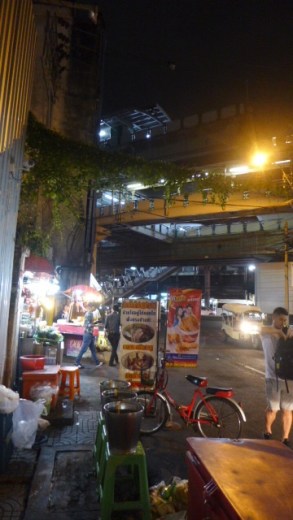 f you could put your feet up it would be a perfect way to sight see.
 karinameiri